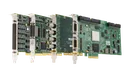
PCI-DIO-96
DIO Series
- NIPCI-DIO-96 Digital I/O Interface with 100-Pin I/O Connector
In Stock | Ships Today


Modules - Power Supplies - Multimeters - Source Measure

Browse active National Instruments PCI part pages, then request a quote for the exact model you need.
DIO Series

MXI-2 Series

DIO Series

PCI Controllers

DAQCards

DAQCards

GPIB Instrument Control Modules

DIO Series
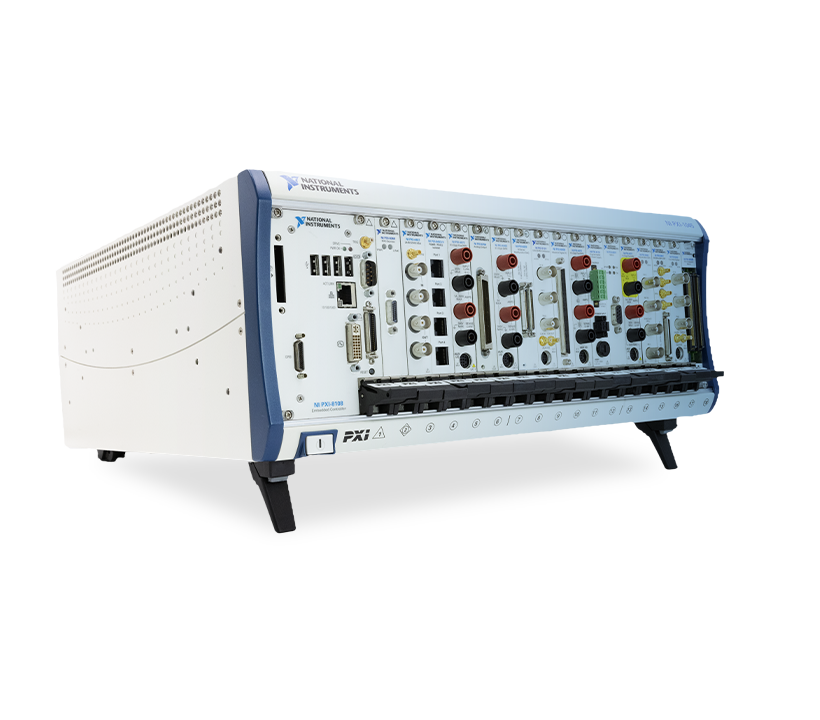
National Instruments PCI hardware turns a compatible desktop or industrial computer into a measurement, control, or instrument communication system. PCI stands for Peripheral Component Interconnect, the expansion bus used by these plug-in boards. Unlike an external USB device or a chassis-based PXI module, a conventional PCI card installs inside the host computer. The family spans several measurement technologies, making the exact model more important than the shared PCI interface.
Multifunction data acquisition is a major part of the portfolio. E Series models such as the PCI-6024E and PCI-6071E support established measurement systems, while M Series devices include the PCI-6221, PCI-6251, and PCI-6281. These product lines combine analog measurement with additional functions that vary by model. Channel count, resolution, analog output capability, digital timing, and counter resources should therefore be checked individually rather than assumed from the series name.
For example, the 68-pin PCI-6221 provides 16 analog inputs with 16-bit resolution, a maximum sampling rate of 250 kS/s, two analog outputs, 24 digital I/O lines, and two 32-bit counters. Its multiplexed analog input architecture shares conversion resources across active channels. It is a practical example of a board that combines voltage acquisition, signal generation, and digital interaction for laboratory automation and production testing.
S Series hardware addresses applications requiring simultaneous sampling. The PCI-6115, offered under part numbers 778534-01 and 778554-01, acquires four analog input channels at up to 10 MS/s per channel with 12-bit resolution. This architecture supports measurements where timing relationships between signals matter, including transient capture and stimulus-response testing. Its full-length board dimensions also illustrate why physical clearance must be verified before selecting a replacement.
Dedicated PCI products extend beyond multifunction DAQ. The PCI-6509 supplies 96 digital I/O channels, while the PCI-6602 provides eight 32-bit counters for tasks such as encoder measurement, event counting, and pulse generation. The PCI-6723 offers 32 analog output channels. PCI-GPIB interfaces connect compatible computers to instruments using the IEEE 488 bus.
Compatible boards can share timing and trigger signals through RTSI connections, enabling coordinated measurements when the necessary cabling, signal routing, and software settings are configured for synchronization.
Successful integration depends on the complete system. Confirm PCI slot compatibility, board dimensions, connector pinouts, cables, terminal blocks, and signal conditioning requirements. PCI and PCI Express are not interchangeable slots. Many NI PCI DAQ boards use NI-DAQmx, but the supported driver release, operating system, and application software must match the specific hardware. Existing applications may also depend on older software configurations.
For established test stations, matching the original PCI hardware can help preserve wiring, application code, and validated procedures. Apex Waves helps customers source legacy NI PCI equipment and evaluate replacement requirements. Provide the model, ordering part number, required accessories, and calibration needs when requesting a quote.
Browse related buying pages and hardware groups for National Instruments PCI.
Buy NI CAN bus interfaces and National Instruments CAN hardware for automotive, embedded, industrial, and diagnostic applications.
Browse NI CAN Bus InterfacesShop NI DAQ hardware and National Instruments data acquisition devices, including USB, PCI, PXI, PXIe, and CompactDAQ systems.
Browse NI DAQ HardwareShop NI data acquisition systems and National Instruments DAQ systems, including USB DAQ, PCIe DAQ, PXI DAQ, and CompactDAQ hardware.
Browse NI Data Acquisition SystemsShop NI FPGA and RIO hardware, including National Instruments CompactRIO, Single-Board RIO, R Series, and FPGA modules.
Browse NI FPGA & RIO HardwareShop NI FPGA hardware and National Instruments FPGA modules, including R Series, PXI FPGA, PXIe FPGA, and reconfigurable I/O hardware.
Browse NI FPGA HardwareBrowse NI modules and cards from National Instruments, including DAQ cards, PXI modules, CompactDAQ modules, CAN interfaces, and digital I/O hardware.
Browse NI Modules & CardsShop NI PCI DAQ cards and National Instruments PCI data acquisition hardware for industrial and laboratory measurement systems.
Browse NI PCI DAQ CardsShop used National Instruments equipment and refurbished NI hardware, including DAQ, PXI, PXIe, CompactDAQ, and CompactRIO systems.
Browse Used National Instruments EquipmentExplore the National Instruments PCI series and product families from the original PCI guide.
The National Instruments S Series devices are Simultaneous Sampling Multifunction DAQs. They are ideal for applications such as ultrasonic, ballistic, and radar transient recording and analysis. These devices are created with an analog-to-digital converter, which makes them superior to other devices regarding throughput and channel preciseness. There are pre/post-analog and digital trigger options. The S Series devices have analog and digital I/O, as well as counters and timers.
The National Instruments Dynamic Signal Acquisition (DSA) Devices deliver dynamic signal generation and acquisition in sound and vibration applications for PXI systems. These devices have features such as antialiasing filters, IEPE conditioning, and software-configurable AC/DC coupling. The DSA Devices are created especially for applications such as noise and vibration diagnostics, automotive test, audio test and measurement, and various others.
The National Instruments R Series of Multifunction Reconfigurable I/O Devices have user-defined, onboard processing for versatility of system timing and triggering. The NI R Series Devices utilize an FPGA that is user-programmable, which allows all analog and digital I/O channels to be configured for application-specific operation. When R Series Devices are utilized with the LabVIEW FPGA Module, users can create applications such as high-speed control, hardware-in-the-loop assessment, sensor simulation, and custom protocol communication.
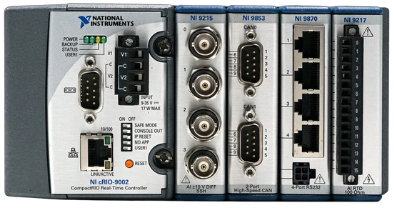
The National Instruments RT Series consists of PXI Controllers and Multifunction I/O Boards, which can be used with LabVIEW RT for a simple to utilize system for real-time applications. The RT Series DAQ Devices contain a processor board and a daughter board. The PXI systems can also be controlled by a host PC to run real-time, embedded LabVIEW RT applications.
The National Instruments High Speed Digital I/O (HSDIO) Devices have programmable voltage levels, 256 MB total onboard memory, and can be used with NI Digital Waveform Editor to generate, import, and edit digital waveforms. The HSDIO Series can be used for many applications, including complicated stimulus-response assessments or interfacing and device simulation.
The National Instruments Timing and Synchronization Modules allow a higher level of synchronization on the PXI family with the use of high-precision triggering, high-stability clocks, and advanced signal routing. These modules can accomplish synchronization over a massive distance via IRIG-B, GPS, PPS, or IEEE 1588. The Timing and Synchronization Modules also have skew reduction with differential star and star lines.
The National Instruments MXI-Express x1 is a cabled PCI Express x1 link, which allows for the control of devices installed in a VXI, CompactRIO, PXI, or PXI Express chassis. MXI-Express x1 controls the device via laptops, workstations, desktop computers, or other types of host controllers with an ExpressCard, PCI, or PCI Express slot. The MXI-Express x1 devices have 1 or 2 ports and fiber-optic or copper cable support.
MXI-4 is a high-bandwidth link designed by National Instruments, which is transparent to drivers and software applications and offers the capability to utilize high-performance servers or desktop computers to control PXI systems. The MXI-4 link comprises a PCI-8331 or PCI-8336 board in a PC, linked with a cable to a PXI-8331 or PXI-8336 module in slot 1 of a PXI Chassis. MXI-4 also has support for 5 V and 3.3 V PCI, which is an improvement upon MXI-3.
The Serial Interface Devices by National Instruments allow users to communicate with and control external serial hardware by utilizing asynchronous serial interfaces with numerous protocols. These devices can add as many as 16 serial ports to a system. Standard serial protocols are supported by these devices, including RS232, RS485, or RS422.
The National Instruments MXI-2 Series is the second generation of the NI MXIbus models, with more signals than the first generation. The MXI-2 Series modules also have a higher data throughput with a maximum of 33 MB/s between two MXI-2 products. The MXI-2 interface kits connect a PCI-based computer or a PXI/CompactPCI Chassis to the VXIbus or VMEbus with the MXI-2 bus.
The National Instruments B Series is a Legacy Series of Multifunction DAQ Devices. This series is an affordable option for PCI data acquisition features, providing 16 SE/8 DI analog inputs, up to 2 analog outputs, 2 counters/timers, and digital triggers. The B Series devices are supported with NI-DAQmx driver software.
The National Instruments PCI CAN (Controller Area Network) Interfaces allow PCs to link to and communicate on a CAN bus. These interfaces utilize onboard transceivers for High-Speed/Flexible Data-Rate, Low-Speed/Fault-Tolerant, Single-Wire, and/or Software-Selectable CAN. The PCI CAN Interfaces have 1 or 2 ports and can be used with the NI-XNET driver software.
The National Instruments PCI Digital Multimeter Devices (DMMs) can complete frequency/period, voltage, current, temperature, and resistance measurements, along with diode tests for PC-based systems. DMMs are equipped with 2- or 4-wire resistance, AC/DC voltage, and AC/DC current.
The National Instruments PCI Controllers are obsolete. This series consist of Motion Controllers such as the PCI-7334 and Switch Controllers like the PCI-4021. The Motion Controllers have the capability to control a maximum of 8 individual axes of motors, while the Switch Controllers control an SCXI-based switching system.
The National Instruments PCI Multifunction Devices are a mixture of digital I/O, analog I/O, as well as counter/timer functions for computer-based systems in one device. These devices can be used for industry applications like design verification, automation, and research. The PCI Multifunction Devices have various sample rates, output rates, and channel counts to meet the requirements of many standard measurements.
The National Instruments PCI Waveform Generator Devices can create user-defined and regular arbitrary waveforms. These Waveform Generators can create several types of accurate waveforms, such as triangle, sine, ramp, and square. The NI PCI Waveform Generator Devices are classified as mature or obsolete.
The National Instruments NI-656x Series of Digital Waveform Generators can be utilized as a pattern generator, stimulus-response tester, PC/peripheral device interface, or pattern analyzer. These Digital Waveform Generators have 16 channels and can create and obtain information at 200 Mb/s or 400 Mb/s. The NI-656x Series also has the capability to utilize NI-TClk to synchronize several instruments.
The National Instruments GPIB Instrument Control Modules integrate non-PXI devices into a PXI system via the GPIB standard. The PXI GPIB Instrument Control Modules have IEEE 488 controllers for PXI systems. The user can select an option that supports Gigabit Ethernet transfer rates.
The National Instruments E Series of Multifunction DAQ Devices are equipped with 16-64 channels, 12 or 16-bit resolution, and sample rates to 1.25 MS/s maximum. The NI E Series devices utilize the National Instruments DAQ system timing controller, otherwise referred to as DAQ-STC for functions relevant to time. This series consists of both PCI and PXI boards.
The National Instruments Digital I/O or DIO Devices deliver digital output and input functions for computer-based systems. The DIO Devices come with varying specifications for current, voltage, and channel count, ensuring the user will be able to find the greatest model for their requirements. The NI DIO Devices additionally have programmable input filters, programmable power-up states, digital I/O watchdogs, and other useful features.
The National Instruments Analog Output Devices can replace many different parts in a system due to their wide range of features. The devices can replace PID controllers, function generators, and low-speed arbitrary waveform generators. These devices offer a range of channel counts, output resolutions, and features. The NI Analog Output Devices allow the user to create applications like signal or sensor simulation, power supply control, and deterministic control.
The National Instruments M Series Multifunction Data Acquisition (DAQ) Devices come with as many as 80 analog input channels, four analog output channels maximum, as many as 48 lines of DIO, and two counters. There are several types of devices in the M Series: Bus-Powered Devices for USB, Industrial Devices, High-Accuracy Devices, Low-Cost Devices, and High-Speed Devices. All NI MI Series Devices can be utilized with NI-DAQmx 15.5 and later.
The National Instruments MXI-3 consists of Interface Boards and Modules which have compatibility for either copper or fiber-optic cabling and 200 m maximum cabling distance. MXI-3 functions as a PCI-to-PCI bridge to complete high performance, as well as hardware and software transparency. The MXI-3 Remote Controllers have a peak rate of 132 Mbytes/s.
Quality processes backed by documented inspection, testing, and fulfillment standards.
Connected to the standards group supporting modular instrumentation platform compatibility and growth.
Every PCI board is inspected and tested for reliable operation.
Quality NI hardware tested before it ships.
Our team helps match the right PCI device to your system.
We stock hard-to-find NI PCI hardware to keep long-running systems online.
Watch Apex Waves PCI videos and hardware guides on YouTube.
Explore related families and modular hardware.