USRP-2920
USRP Software Defined Radio Devices
- National Instruments USRP-2920- 1 input channel
In Stock | Ships Today
Buy NI USRP SDR systems and National Instruments software defined radio hardware for wireless research, RF testing, and communications systems.

Browse the models highlighted for this page, then request a quote for the exact National Instruments hardware you need.
USRP Software Defined Radio Devices
USRP Software Defined Radio Devices
USRP Software Defined Radio Devices
USRP Software Defined Radio Devices
USRP Software Defined Radio Devices
USRP Software Defined Radio Devices
USRP Software Defined Radio Devices
USRP Software Defined Radio Devices
NI USRP SDR systems combine tunable radio frequency hardware with software-defined signal processing for communications research, teaching, and wireless prototyping. USRP stands for Universal Software Radio Peripheral, while SDR means software-defined radio. Instead of relying entirely on fixed-function circuitry, engineers develop modulation, demodulation, filtering, and signal analysis in software. This flexibility supports experiments involving wireless links, spectrum sensing, cognitive radio, and multiple-input, multiple-output (MIMO) communications.
The NI portfolio includes several USRP series with different interfaces, frequency ranges, and processing capabilities. USB-connected USRP-290x devices provide a compact starting point for laboratory work. The USRP-2900, part number 784039-01, offers one transmit channel and one receive channel. The USRP-2901, part number 784040-01, provides two transmit and two receive channels for MIMO experiments. Both cover 70 MHz to 6 GHz and specify up to 56 MHz instantaneous bandwidth. Achievable streaming performance depends on the interface, active channel count, sample format, and host computer.
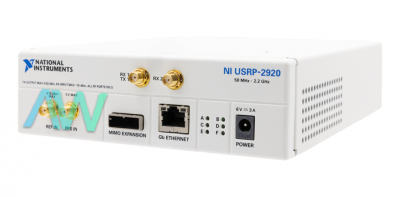
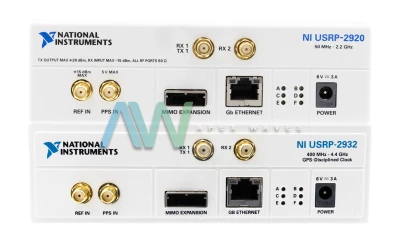
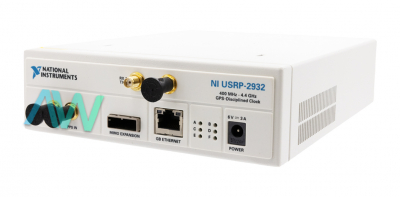
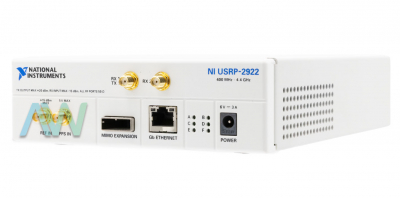
Ethernet-connected USRP-292x and USRP-293x models support established research and teaching systems. Examples include the USRP-2920 and USRP-2930, which cover 50 MHz to 2.2 GHz, and the USRP-2922 and USRP-2932, which cover 400 MHz to 4.4 GHz. The USRP-293x family incorporates GPS-disciplined oven-controlled crystal oscillators for improved frequency accuracy and synchronization. These timing features are useful when coordinating distributed radios, although successful synchronization still requires appropriate reference configuration and system design.
For applications requiring custom hardware processing, USRP RIO products in the USRP-294x and USRP-295x families provide programmable FPGA resources. Representative models include the USRP-2943, USRP-2944, and USRP-2954. The USRP-2954, part number 783153-01, combines two transmit channels, two receive channels, a Kintex-7 410T FPGA, and a GPS-disciplined reference clock. Its tuning range extends from 10 MHz to 6 GHz, with up to 160 MHz instantaneous bandwidth, subject to operating conditions. FPGA processing allows suitable tasks to run close to the radio hardware rather than relying exclusively on host processing.
Frequency coverage and instantaneous bandwidth describe different capabilities: tuning range identifies where a radio operates, while bandwidth indicates how much spectrum it can process at once. A broad tuning range therefore does not mean the device captures that entire range simultaneously at one frequency setting.
Software selection is equally important. Compatible NI-USRP driver releases support LabVIEW development, while supported UHD configurations enable workflows using GNU Radio and other environments. FPGA customization requires suitable hardware, development tools, and interface support; it is not interchangeable across every USRP model.
When sourcing NI USRP equipment from Apex Waves, identify the complete model and ordering part number, required frequency coverage, channel count, and bandwidth configuration. Review the existing software environment, power supply, RF cables, attenuators, antennas, and synchronization accessories before choosing a replacement. Matching these details helps preserve established laboratory workflows and avoids purchasing hardware that cannot meet the intended application.
Continue browsing related National Instruments buying pages and hardware groups.
Buy NI CAN bus interfaces and National Instruments CAN hardware for automotive, embedded, industrial, and diagnostic applications.
Browse NI CAN Bus InterfacesShop NI DAQ hardware and National Instruments data acquisition devices, including USB, PCI, PXI, PXIe, and CompactDAQ systems.
Browse NI DAQ HardwareShop NI data acquisition systems and National Instruments DAQ systems, including USB DAQ, PCIe DAQ, PXI DAQ, and CompactDAQ hardware.
Browse NI Data Acquisition SystemsShop NI digitizers and National Instruments high-speed digitizer hardware for PXI, PXIe, waveform capture, and automated test systems.
Browse NI DigitizersShop NI FPGA and RIO hardware, including National Instruments CompactRIO, Single-Board RIO, R Series, and FPGA modules.
Browse NI FPGA & RIO HardwareShop NI FPGA hardware and National Instruments FPGA modules, including R Series, PXI FPGA, PXIe FPGA, and reconfigurable I/O hardware.
Browse NI FPGA HardwareBrowse NI modules and cards from National Instruments, including DAQ cards, PXI modules, CompactDAQ modules, CAN interfaces, and digital I/O hardware.
Browse NI Modules & CardsBuy NI PXI CAN interfaces and National Instruments PXI CAN hardware for automotive, embedded, and industrial communication systems.
Browse NI PXI CAN InterfacesShop NI PXI digitizers and National Instruments PXI digitizer hardware for waveform capture and high-speed measurement systems.
Browse NI PXI DigitizersShop NI PXI Ethernet interface modules and National Instruments PXI communication hardware for modular test systems.
Browse NI PXI Ethernet Interface ModulesShop NI PXI modules and National Instruments PXI cards for DAQ, switching, RF, waveform, communication, and automated test systems.
Browse NI PXI ModulesShop NI PXI oscilloscopes and National Instruments PXI scope hardware for waveform capture and signal analysis.
Browse NI PXI OscilloscopesBuy NI PXI systems, chassis, controllers, and modules from Apex Waves. Shop tested National Instruments PXI hardware with quote support.
Browse NI PXI SystemsBuy NI RF signal analyzers and National Instruments RF analyzer hardware for spectrum analysis, wireless testing, and PXI RF systems.
Browse NI RF Signal AnalyzersBuy NI strain gauge modules and National Instruments bridge input modules for load cell, force, torque, and structural testing applications.
Browse NI Strain Gauge ModulesBrowse NI test and measurement equipment from National Instruments, including DAQ systems, PXI hardware, oscilloscopes, digitizers, and RF modules.
Browse NI Test & Measurement EquipmentShop used National Instruments equipment and refurbished NI hardware, including DAQ, PXI, PXIe, CompactDAQ, and CompactRIO systems.
Browse Used National Instruments EquipmentQuality processes backed by documented inspection, testing, and fulfillment standards.
Connected to the standards group supporting modular instrumentation platform compatibility and growth.
Each available unit is inspected and tested for dependable operation before shipment.
Our team helps match models, part numbers, replacements, and compatible alternatives.
Explore nearby National Instruments families and related hardware.